Utah's Gerrymandering Saga
From Salamanders to Supreme Court Showdowns
A Quick History Lesson
Massachusetts, 1812. Governor Elbridge Gerry had just signed a map that helped his party win 29 of 40 state senate seats. His party got fewer votes than the other side, but won almost everything anyway.
A newspaper cartoonist looks at one of the new districts and thinks, "That looks like a salamander." He draws claws, adds wings and teeth, and publishes it with a joke: "Gerry-mander."
The word stuck. Two hundred years later, politicians still do the same thing, only now with software that can test thousands of maps in seconds instead of a hand-drawn one.
So What IS Gerrymandering?
Every ten years, the Census counts everybody and states redraw their district maps. That makes sense: people move, some places grow, others shrink, and districts have to have roughly equal populations.
Whoever redraws the lines can rig the game with two tricks.
Packing Cram your opponents into one district and let them win it by a landslide. Winning with 51% counts the same as winning with 99%. It's like letting your rival score 50 points in one game, so they're too tired to win the next five. Picture Salt Lake as a blue "donut hole" that wins one district big while the rest of Utah stays red.
Cracking Split your opponents across several districts so they're a minority everywhere. A city that votes 60% one way isn't a majority anywhere if it's carved into four pieces. Picture Salt Lake City where four "pizza slices" meet: the tip of each slice is blue, the rest is red.
Both tricks are about "wasting" the other side's votes.
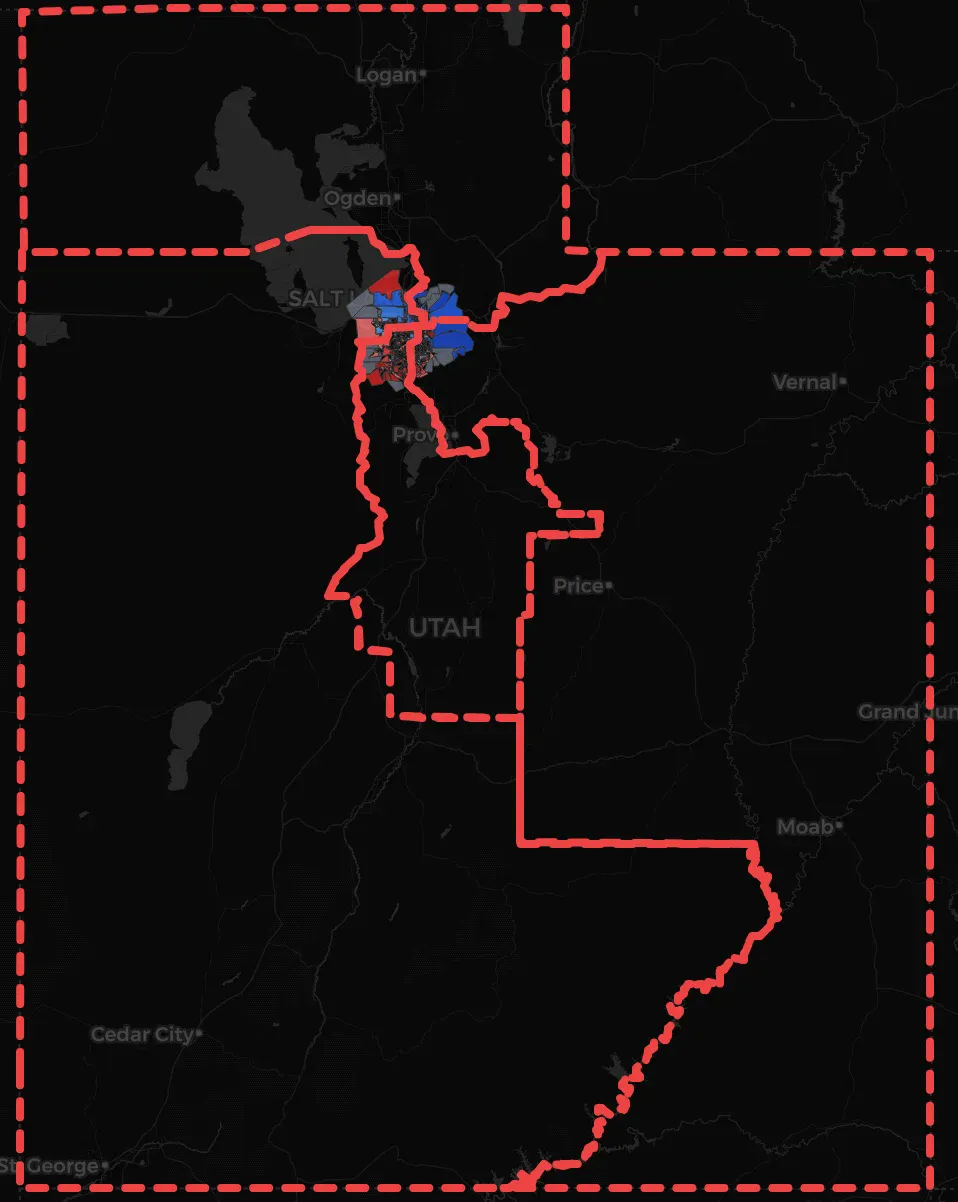
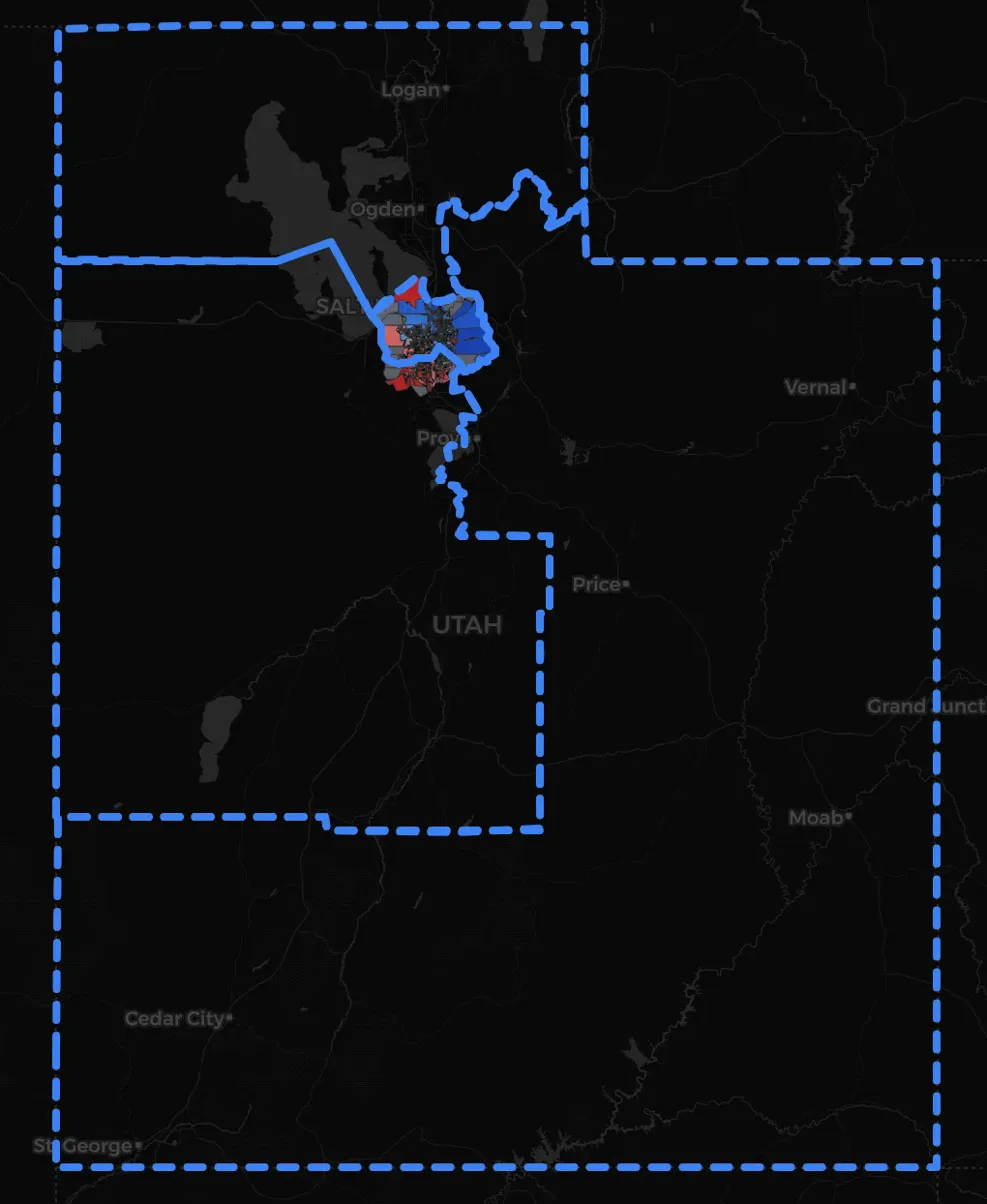
Pi Pizzeria? The Pie Hole? Centro?
The pizza problem here in Utah isn't delicious.
Salt Lake County has about one-third of Utah's people, and most of its Democratic voters. After the 2010 Census, the Legislature had a choice: keep Salt Lake County mostly together, or slice it up.
Slice, slice, slice. They chose the pizza. Yum.
The 2011 map split Salt Lake County across three congressional districts, pairing parts of Salt Lake City with rural areas hundreds of miles away. One pollster put it bluntly: "If those who drew the districts want Utah to remain as a one-party state, they've done a darn good job."
After the 2020 Census, they did it again, with four slices instead of three. Under the old lines, Trump won the 4th District by about 9 points. Under the new lines, the same voters would have given him about 26. Same voters, different lines.
Ben McAdams had won the 4th District in 2018 by just 694 votes, then lost it in 2020 by less than a point. After the 2021 map, analysts called the redrawn district "virtually impossible for a Democrat to win."
The Voters Fight Back
Utah voters weren't having it. In 2018, a group called Better Boundaries put Proposition 4 on the ballot: an independent commission would draw maps instead of politicians, with rules against favoring a party.
The vote was incredibly close: 50.34% to 49.66%, a margin of about 7,000 votes.
So everyone is properly represented now? All is good in the world? Yes… until the Legislature threw it in the trash can. "Kobe!"
In 2020, lawmakers passed SB 200, which made the commission "advisory." Small words like "may," "must," "must not" and "advisory" are easy to miss, but they can change what a whole bill means. That one word turned the voters' shout into a whisper: the Legislature could ignore the commission and didn't have to explain why.
The voters said "we want fair maps." The Legislature said "that's cute, but no," and sent us to bed without a glass of milk and a hug.
The Courts Step In
In 2022, the League of Women Voters of Utah, Mormon Women for Ethical Government and several voters sued. Their argument: you can't gut what the voters passed. Here's how it played out.
- The Utah Supreme Court rules unanimously that the people have a constitutional right to reform their government by initiative, and the Legislature can't simply override it.
- Lawmakers put Amendment D on the ballot to let them change voter-passed laws. The courts void it before it can take effect.
- Judge Dianna Gibson strikes down SB 200 and the 2021 map: "Proposition 4 is the law on redistricting in Utah." She orders new maps.
- The Legislature passes a replacement, "Map C." Experts testify it is more Republican than nearly every map a neutral process would produce; the judge later calls it "an extreme partisan outlier."
- The judge rejects Map C and picks Map 1, submitted by the groups that sued. It keeps most of Salt Lake County in one district that leans Democratic; the other three lean Republican.
The Legislature was furious. One representative floated impeaching the judge; leadership walked that back pretty quick.
The Legislature Fights Back
- In a special session, lawmakers condemn the ruling, move the congressional filing deadline to March, and send redistricting appeals straight to the Utah Supreme Court.
- The Utah Supreme Court dismisses the Legislature's appeal because the case isn't final yet. A federal panel refuses to bring back the 2021 map. Lawmakers also create a new three-judge "constitutional court" for challenges to state laws, which is itself being challenged.
- A citizen initiative to repeal Prop 4 turns in more than 200,000 signatures. Then enough voters ask to have their names removed that it falls short in key Senate districts. On April 30, the lieutenant governor rules it won't be on the ballot.
- Ben McAdams wins the Democratic primary in the new 1st District.
- Legislative leaders drop plans to put an amendment limiting citizen initiatives on the November 2026 ballot, saying they'll let the courts finish first. November 3, 2026 is the first general election under Map 1.
Try drawing the lines yourself. Pack, crack, or flip a practice state, then compare Utah's 2021 and 2026 maps on real election results.
Play Draw the LinesWhy Should You Care?
Gerrymandering doesn't just affect one party. It affects everyone. When politicians pick their voters instead of voters picking their politicians, accountability disappears. Why would a representative listen to you if they'll win by 30 points no matter what?
The Big Questions
1. Should politicians draw their own district lines?
2. What makes a map "fair" anyway?
Harder than it sounds. Should every district be competitive? Should seats match the statewide vote? Should maps keep communities together, or be compact? All reasonable, and they sometimes conflict. Keeping Salt Lake County together gives Democrats one safe seat but can make the other three uncompetitive. Spreading it out might make races closer but splits neighborhoods apart.
There's no obvious right answer. Maybe that's exactly why it should be decided by someone who doesn't benefit from the decision.
3. Does it matter if gerrymandering hurts "your side" or "their side"?
Both parties gerrymander when they get the chance. Maryland's Democrats carved up Republican areas just like Utah's Republicans carved up Democratic ones. If you only care when it hurts your team, do you care about gerrymandering, or just about winning?
Our post on the Political Ladder is about climbing past tribal loyalties. Picking a team is fun in sports: we put on our BYU or Utah gear and watch Us vs. Them play out. In politics, it can have real consequences.
What Happens Next?
Utah's story still isn't finished. The Legislature's appeal of the larger case is waiting for a hearing at the Utah Supreme Court, which lawmakers recently expanded from five justices to seven. The fight over the new "constitutional court" is still in the courts. Leaders shelved their amendment to limit citizen initiatives for 2026, but say it could come back as soon as 2028. And after the 2030 Census, the maps get redrawn again.
So let's ask ourselves again: do we want a democracy where voters pick their representatives, or where representatives pick their voters?
Your Turn
Play Draw the Lines. Start with the practice state to learn packing and cracking, then see Utah's real maps. Draw a pizza slice, a donut hole, or a salamander just for fun.
Look up your congressional district. Is it compact or strange-looking? Who drew it? What did it look like before?
I want to end by telling you to contact your legislators and make your voice heard… but would that make a difference? Isn't that the exact point?
Our system is supposed to be about the people deciding. If the maps are rigged before anyone votes, is it really the people deciding?
- Brennan Center for Justice, "Utah's Circuitous Route to Fair Congressional Districts", Jan. 6, 2026
- Redistricting Online, "Utah's Court-Ordered Redistricting: Where Things Stand", May 22, 2026
- Utah News Dispatch, "Judge orders Utah Legislature to draw new congressional maps", Aug. 25, 2025
- Utah News Dispatch, "Federal panel denies bid to overturn Utah's court-ordered congressional map", Feb. 23, 2026
- Utah News Dispatch, "Effort to repeal Utah anti-gerrymandering law officially fails", Apr. 30, 2026
- Deseret News / AP, "Ben McAdams wins Democratic primary in Utah's 1st District", June 23, 2026
- Daily Herald / Utah News Dispatch, "Utah lawmakers now won't pursue constitutional amendment to change ballot initiative power", July 9, 2026
- 2018 Utah Proposition 4: results and background